
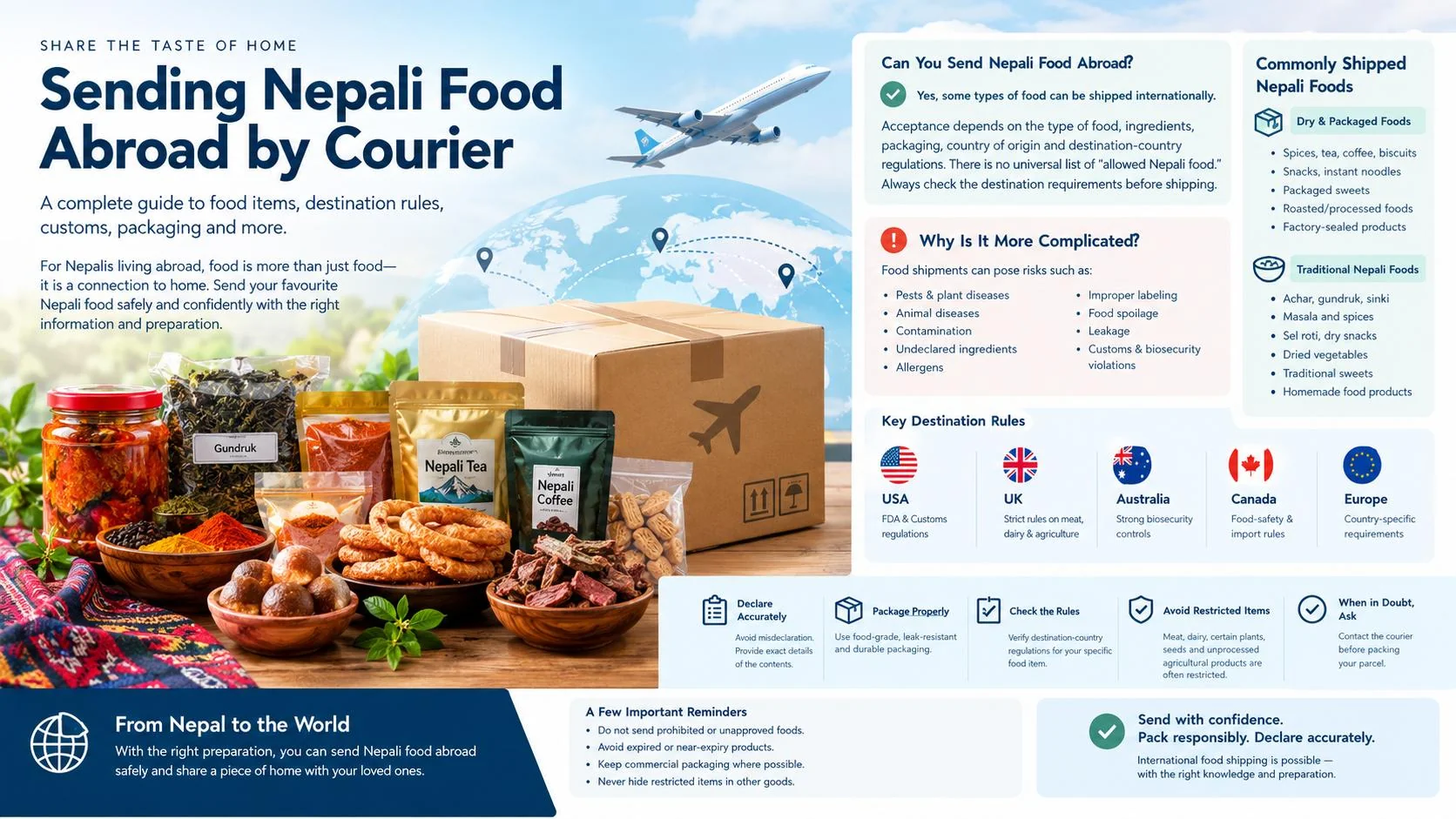
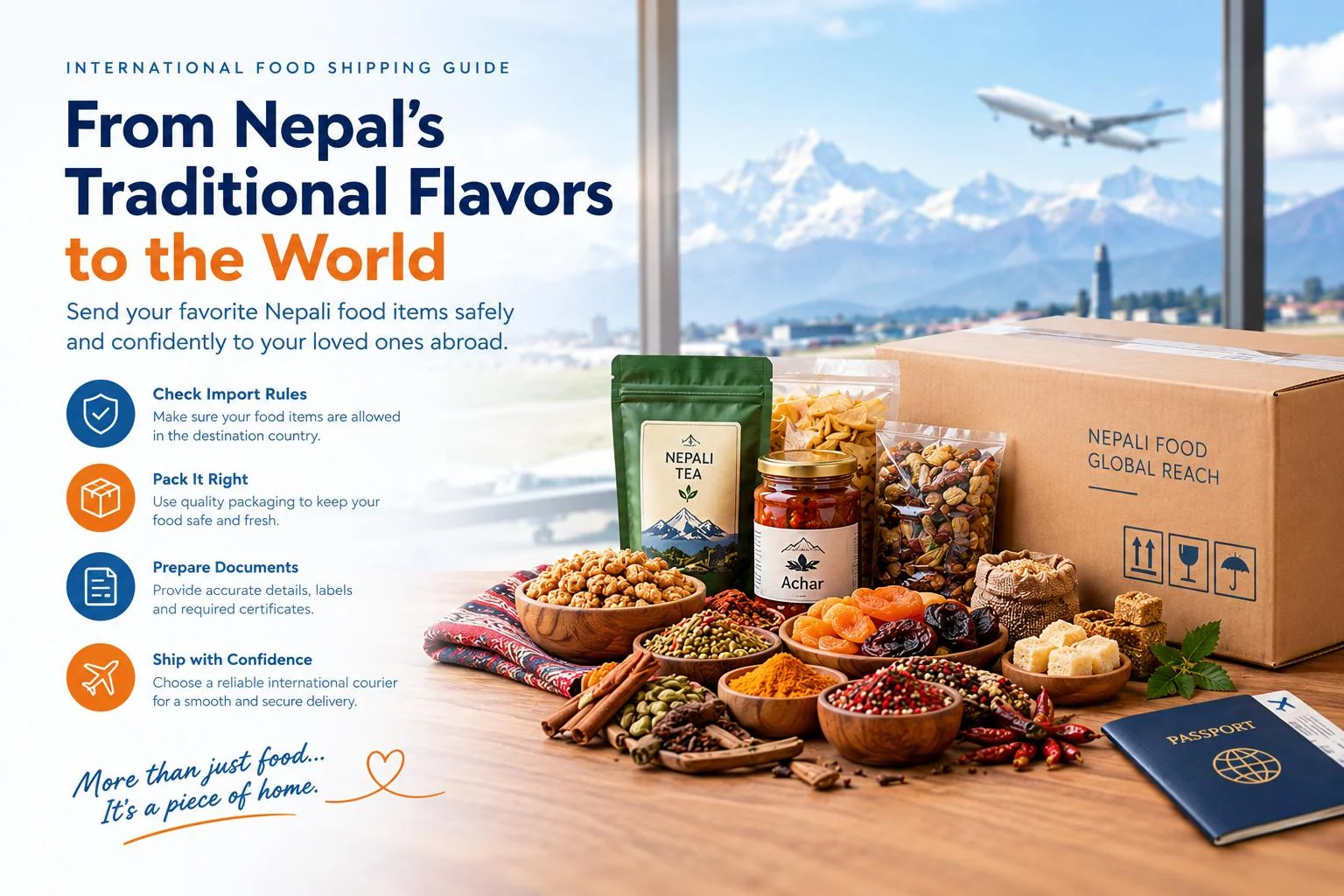
Nepali food is more than something to eat—it is a connection to home.
For Nepalis living abroad, receiving traditional foods from Nepal can bring back memories of family, festivals, celebrations, and everyday life. From roasted snacks and spices to tea, dried foods, traditional sweets, and carefully prepared packaged products, many Nepali food items have strong demand among the Nepali diaspora.
However, sending food from Nepal to another country is not as simple as putting it in a box and handing it to a courier company.
International food shipments involve packaging, documentation, destination-country regulations, customs clearance, product restrictions, shelf life, and transportation conditions. A food item that can be legally purchased in Nepal may not necessarily be permitted for import into another country.
This guide explains the key things you should understand before sending food from Nepal to the USA, UK, Europe, Japan, Australia, or other international destinations.
Planning to send food abroad?
Check the destination country's import rules, confirm that your food items are permitted, and prepare the necessary packaging and documents before booking your international shipment.
Why Do People Send Food from Nepal Abroad?
There are many reasons Nepali families and businesses send food overseas.
Nepali students, workers, families, and communities living abroad often miss familiar tastes from home. During Dashain, Tihar, Teej, New Year, birthdays, weddings, and other special occasions, families may want to send traditional food products and gifts to relatives overseas.
Businesses also send Nepali food products internationally as commercial samples, gifts, or export consignments.
Popular categories may include:
- Nepali tea
- Packaged snacks
- Dried fruits
- Dried vegetables
- Spices and spice blends
- Roasted grains and snacks
- Packaged traditional foods
- Pickles, where permitted
- Processed and commercially packaged food
- Nepali sweets, depending on destination regulations
- Food gift packages
- Shelf-stable specialty products
The important point is that the exact rules depend on the product and destination country.
Is It Legal to Send Food from Nepal Overseas?
In many cases, yes—but not every food product is automatically acceptable.
International food shipments are subject to two different levels of requirements.
1. Nepal-Side Requirements
The shipment may need to comply with Nepal's food safety, export, customs, and product certification requirements.
The Department of Food Technology and Quality Control (DFTQC) is Nepal's government authority responsible for food laws, standards, quality control, inspection, laboratory testing, and food import/export certification.
DFTQC also maintains food standards and regulations covering different categories of food products.
2. Destination-Country Requirements
The country receiving the package may have its own rules concerning:
- Food ingredients
- Animal products
- Plant products
- Meat and dairy
- Fresh fruits and vegetables
- Seeds
- Homemade foods
- Pickles and sauces
- Alcohol-containing products
- Food labeling
- Commercial imports
- Quantity limits
- Packaging
- Expiry dates
- Customs declarations
Important to remember
Food accepted for international courier transportation is not automatically guaranteed to clear customs in the destination country.
What Makes Food Shipping Different from Normal Parcel Shipping?
A normal parcel might contain clothes, books, documents, or household items.
Food is different because it can affect public health, agriculture, and biosecurity.
For example, certain plant products may require phytosanitary certification. Nepal's Trade and Export Promotion Centre notes that a phytosanitary certificate is mandatory for exporting plants and plant products under Nepal's plant-protection framework.
That is why a professional international courier should evaluate the contents before accepting a food shipment.
Which Nepali Foods Are Generally Easier to Ship?
As a general rule, commercially manufactured, sealed, shelf-stable foods are often easier to handle than fresh or homemade foods.
Packaged Snacks
Factory-sealed snacks with clear ingredient information, manufacturing details, and expiry information are generally easier to document.
Nepali Tea
Nepali tea can be a popular international gift and commercial product. Proper commercial packaging helps protect the product during transportation.
Packaged Spices
Packaged spices and spice blends may be suitable for international shipping depending on the destination's regulations.
Dried Foods
Some dried food products can travel well because they have a longer shelf life and do not require refrigeration.
However, "dried" does not automatically mean "allowed." Destination-country rules still apply.
Why Fresh and Homemade Foods Can Be More Difficult
Fresh food presents additional challenges because of its short shelf life and potential agricultural or food-safety risks.
Homemade foods can also be difficult because customs authorities may need information about ingredients, preparation, packaging, labeling, and origin.
Products containing animal-derived ingredients may face additional restrictions in certain countries.
For this reason, customers should always declare the actual contents of the shipment rather than describing food as something else.
Incorrect declarations can create customs problems, delays, additional charges, or even shipment rejection.
The Importance of Proper Food Packaging
Packaging is one of the most important parts of an international food shipment.
A food package can pass through multiple handling points, warehouses, vehicles, airports, and customs facilities before reaching the recipient.
Good packaging should help protect against:
- Crushing
- Moisture
- Leakage
- Contamination
- Odor transfer
- Temperature fluctuations
- Rough handling
- Accidental opening
For suitable products, use the manufacturer's original sealed packaging whenever possible.
The outer courier box should also provide enough protection so that individual food packages do not move excessively inside the parcel.
Food Labels Matter
For packaged food, accurate labeling is extremely important.
DFTQC's published guidance indicates that packaged food labels can require information such as the food name, ingredients, manufacturer information, production date, expiry/consumption date, batch number, storage instructions where applicable, and license information.
This is one reason commercially manufactured and properly labeled food products can be more straightforward to ship internationally than loosely packed homemade food.
Common Documents and Information for Food Shipments
The exact documentation depends on the product, destination, shipment type, and applicable regulations.
Depending on the shipment, information may include:
- Sender's full details
- Recipient's full details
- Accurate product description
- Quantity
- Weight
- Declared value
- Country of origin
- Product ingredients
- Commercial invoice, where applicable
- Packing information
- Food-related certificates, where required
- Phytosanitary documentation for applicable plant products
- Import permits or other destination-country documentation, where required
For commercial exports, additional documentation may be necessary.
A reliable courier should help identify the information required before the shipment is dispatched.
Why Customs Clearance Can Cause Food Shipment Delays
Customs clearance is one of the most important stages of international food shipping.
A shipment may be delayed when:
- The product description is incomplete
- The declared value is inaccurate
- Required documents are missing
- The destination country restricts the product
- Customs requests additional information
- The product requires inspection
- The shipment contains a restricted ingredient
- Packaging or labeling creates questions
- The recipient needs to provide information
- Duties, taxes, or other charges are applicable
Importantly, a courier company cannot override the laws of the destination country.
Customs authorities ultimately decide whether an imported product can enter the country.
USA Food Shipments from Nepal
The United States has detailed requirements concerning imported food and agricultural products.
This means customers sending food from Nepal to the USA should not assume that a food product is acceptable simply because it is commonly available in Nepal.
Before sending a food package to the USA, check:
- What exactly is inside the package?
- Is the product commercially packaged?
- Does it contain meat, dairy, seeds, fresh produce, or other restricted ingredients?
- Does the product have an appropriate label?
- Is the product within its shelf life?
- Are any additional declarations or permits required?
For commercial shipments, requirements can be more extensive than for a personal gift.
Sending Nepali Food to the UK and Europe
The UK and European countries also apply their own food, customs, and biosecurity rules.
The requirements may vary according to:
- Country
- Food category
- Ingredients
- Quantity
- Personal or commercial purpose
- Packaging
- Country of origin
- Animal or plant content
Therefore, customers should check the rules applicable to the specific destination rather than relying on a general statement that "food is allowed."
Personal Food Gifts vs. Commercial Food Exports
This distinction is extremely important.
Personal Shipment
A family sending a small quantity of permitted packaged food to a relative overseas may have different requirements from a business exporting food commercially.
Commercial Shipment
A company exporting food products may need additional documentation, certifications, labeling compliance, invoices, and regulatory approvals.
The shipping process should therefore begin by identifying whether the shipment is:
Personal → Gift → Commercial → Sample → Export Consignment
This helps determine what documentation and customs procedures may apply.
Common Mistakes to Avoid When Sending Food from Nepal
1. Hiding Food Inside Another Item
Never conceal food in clothing, luggage, or another product. Declare the actual contents.
2. Sending Expired Food
International transportation can take time. Always check the expiry date before shipping.
3. Using Weak Packaging
A food product that arrives damaged can become unusable even if it successfully clears customs.
4. Sending Prohibited Products
Always check destination-country restrictions before booking the shipment.
5. Giving an Inaccurate Description
"Gift" is not an adequate product description by itself. A better declaration identifies what the package actually contains.
6. Ignoring Plant and Animal Restrictions
Certain agricultural and animal-derived products can be subject to additional controls.
7. Assuming Every Country Follows the Same Rules
A product accepted in one country may be restricted in another.
How Hulak Express Helps with International Food Shipments
At Hulak Express, we understand that sending a parcel internationally is about more than transportation.
For customers sending food from Nepal to family members, friends, students, businesses, and communities abroad, we focus on making the shipping process clear and organized.
Our international courier service can help customers understand:
- Whether the proposed shipment can be accepted
- How the parcel should be packaged
- What information needs to be declared
- What documents may be required
- How the shipment will be processed
- What information the recipient may need for customs clearance
The final decision to allow an item into a destination country always rests with the relevant customs and regulatory authorities.
A Simple Checklist Before Sending Food Abroad
Before handing your parcel to a courier, use this checklist:
Food Shipping Checklist
- ✓ Is the food legally permitted at the destination?
- ✓ Is the product properly packed?
- ✓ Is the package sealed and protected against leakage?
- ✓ Is the food within its expiry date?
- ✓ Are the ingredients identifiable?
- ✓ Is the product label clear?
- ✓ Have I declared the contents accurately?
- ✓ Have I provided the correct quantity and value?
- ✓ Could the product contain plant or animal material requiring additional controls?
- ✓ Have I checked destination-country requirements?
If you can answer these questions confidently, you are much better prepared for an international food shipment.
Why Choosing the Right Courier Matters
Food shipments require more attention than ordinary parcels.
A courier experienced in international shipping can help identify potential issues before the parcel enters the transportation network.
That can reduce the possibility of:
- Unnecessary delays
- Documentation problems
- Incorrect declarations
- Packaging failures
- Customs complications
At the same time, customers should understand that no courier can guarantee customs clearance for a restricted or incorrectly declared product.
The safest approach is always to provide accurate information from the beginning.
Send Nepali Food and Memories Around the World with Hulak Express
For Nepalis living overseas, a parcel from Nepal can mean much more than its contents.
A packet of tea can remind someone of home. Traditional snacks can bring back childhood memories. A carefully prepared food gift can make a festival feel closer, even when family members are thousands of kilometers away.
But international food shipping needs preparation.
From Nepal to the USA, UK, Europe, Japan, Australia, and other international destinations, make sure your food shipment is properly packed, accurately declared, and suitable for the destination country's import requirements.
Hulak Express is here to help you send your permitted parcels from Nepal to the world with care and confidence.
Ready to Send a Food Parcel from Nepal?
Before booking your shipment, contact Hulak Express with:
- The food item's name
- Quantity
- Approximate weight
- Destination country
- Whether it is a personal gift or commercial shipment
Our team can help you understand the shipping process and the information required for your international parcel.
Hulak Express — Connecting Nepal to the World, One Parcel at a Time.
Frequently Asked Questions
Can I send Nepali food from Nepal to the USA?
Some food products can be shipped to the USA, but acceptance depends on the specific food, ingredients, quantity, packaging, and applicable US import requirements. Always check the product before shipping.
Can I send homemade food internationally from Nepal?
Some homemade foods may be restricted or difficult to clear through customs. Commercially packaged, properly labeled, shelf-stable products are often easier to evaluate, but destination-country rules still apply.
Can I send spices from Nepal abroad?
Certain packaged spices may be accepted, depending on the destination country and product. Plant-based products can be subject to additional controls, so accurate product information is important.
Can I send pickles from Nepal to another country?
It depends on the ingredients, packaging, quantity, destination, and import regulations. Leakage prevention and accurate declaration are especially important for liquid or semi-liquid foods.
What food products are difficult to ship internationally?
Fresh produce, meat, dairy products, homemade foods, seeds, certain plant materials, and products containing restricted ingredients can present additional challenges.
Do I need a phytosanitary certificate?
Certain plant and plant products can require phytosanitary certification. Nepal's Trade and Export Promotion Centre states that phytosanitary certification is mandatory for exporting plants and plant products under Nepal's applicable plant-protection framework.
Can Hulak Express guarantee that customs will accept my food parcel?
No courier can guarantee customs approval. Customs and other government authorities in the destination country make the final decision. Hulak Express can help customers provide accurate shipment information and follow the applicable shipping process.
What is the safest way to send food from Nepal?
Use permitted products, keep them properly sealed and packaged, check expiry dates, provide accurate descriptions and values, and verify destination-country requirements before shipping.


Comments (0)
No comments yet. Be the first to comment!
Leave a Comment