
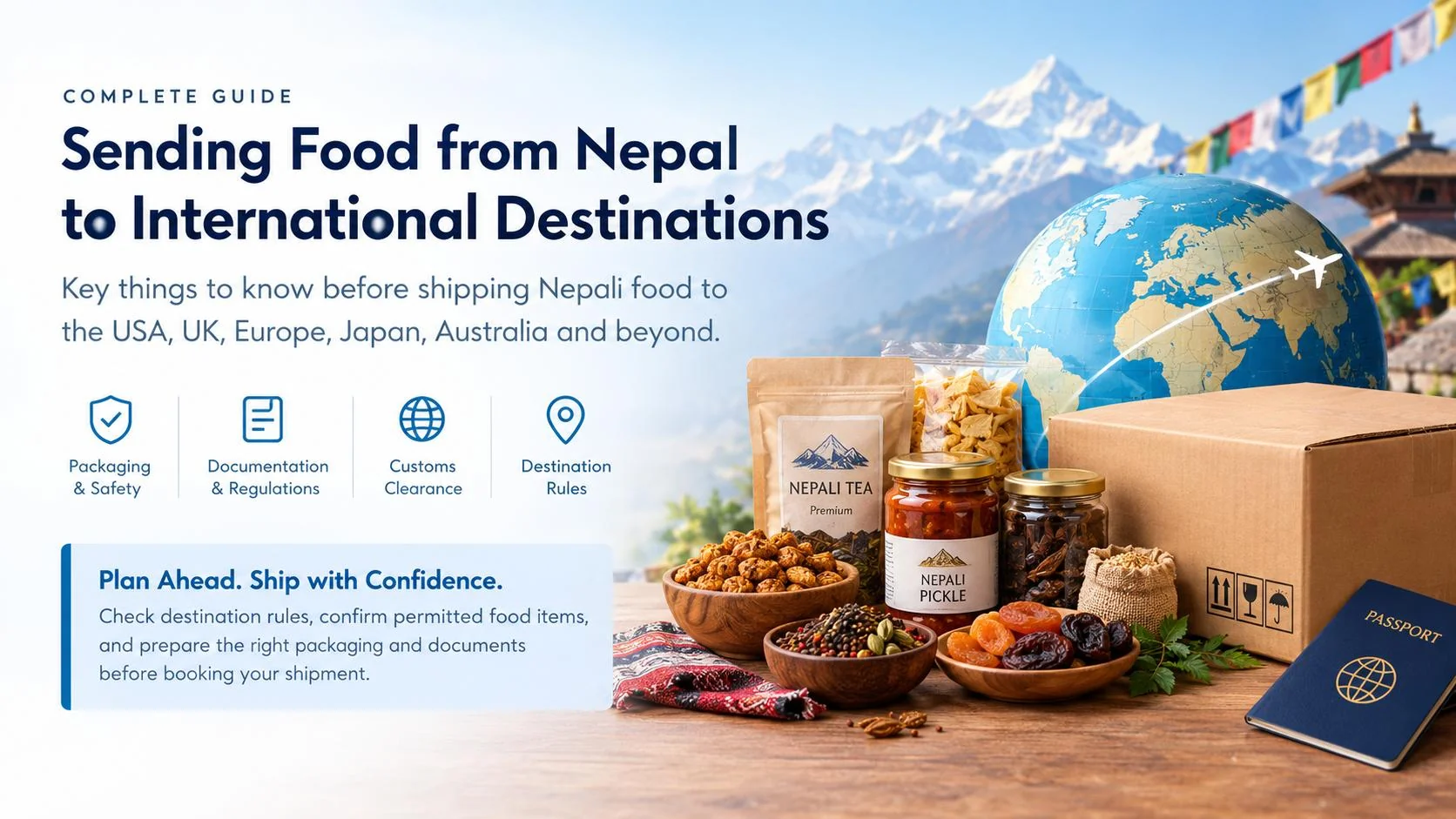
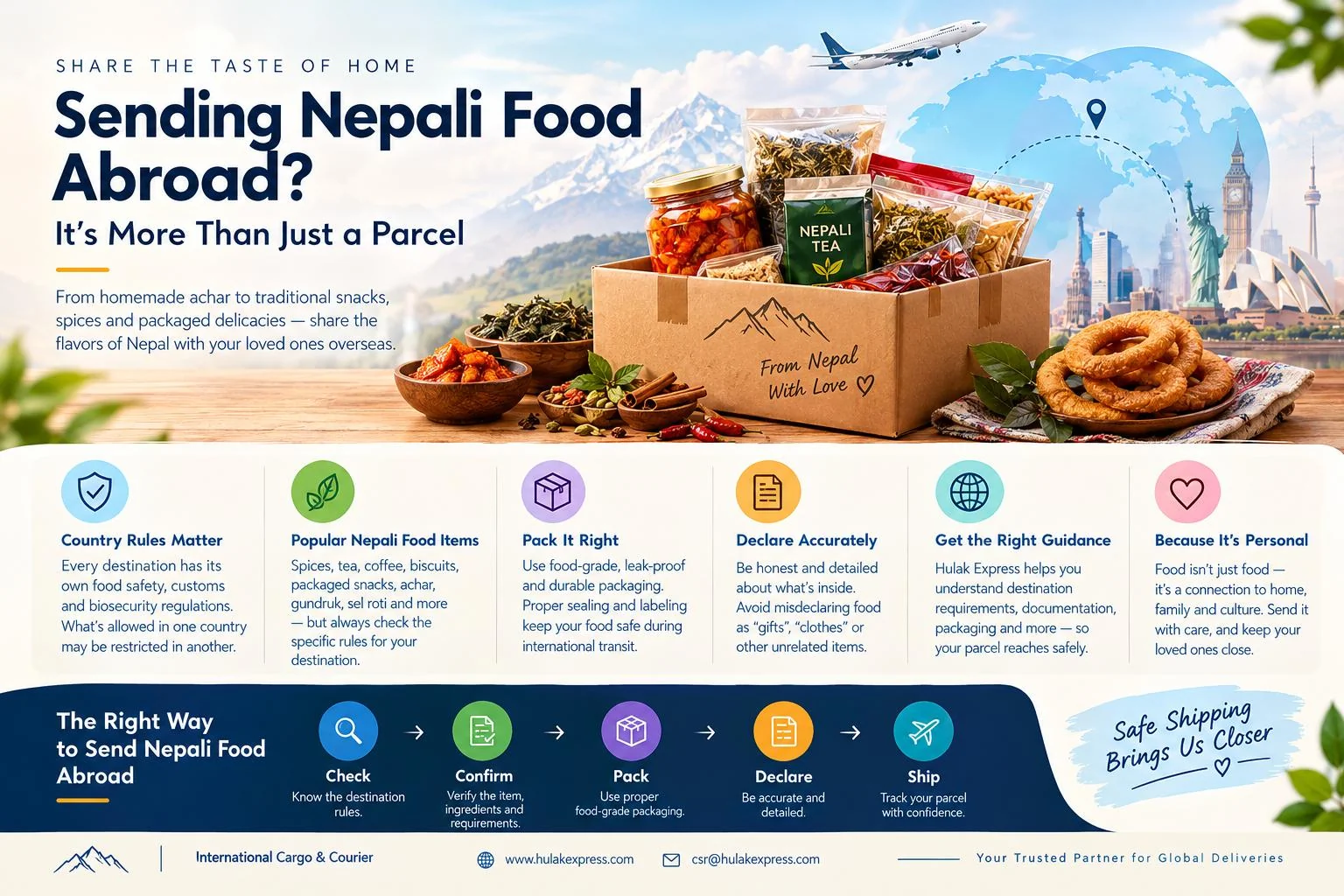
For Nepalis living abroad, food is more than just food—it is a connection to home.
From achar, gundruk and spices to traditional snacks, sweets and packaged Nepali products, sending food from Nepal to family and friends overseas has become increasingly common. However, international food shipping is very different from sending clothes, documents or ordinary household items.
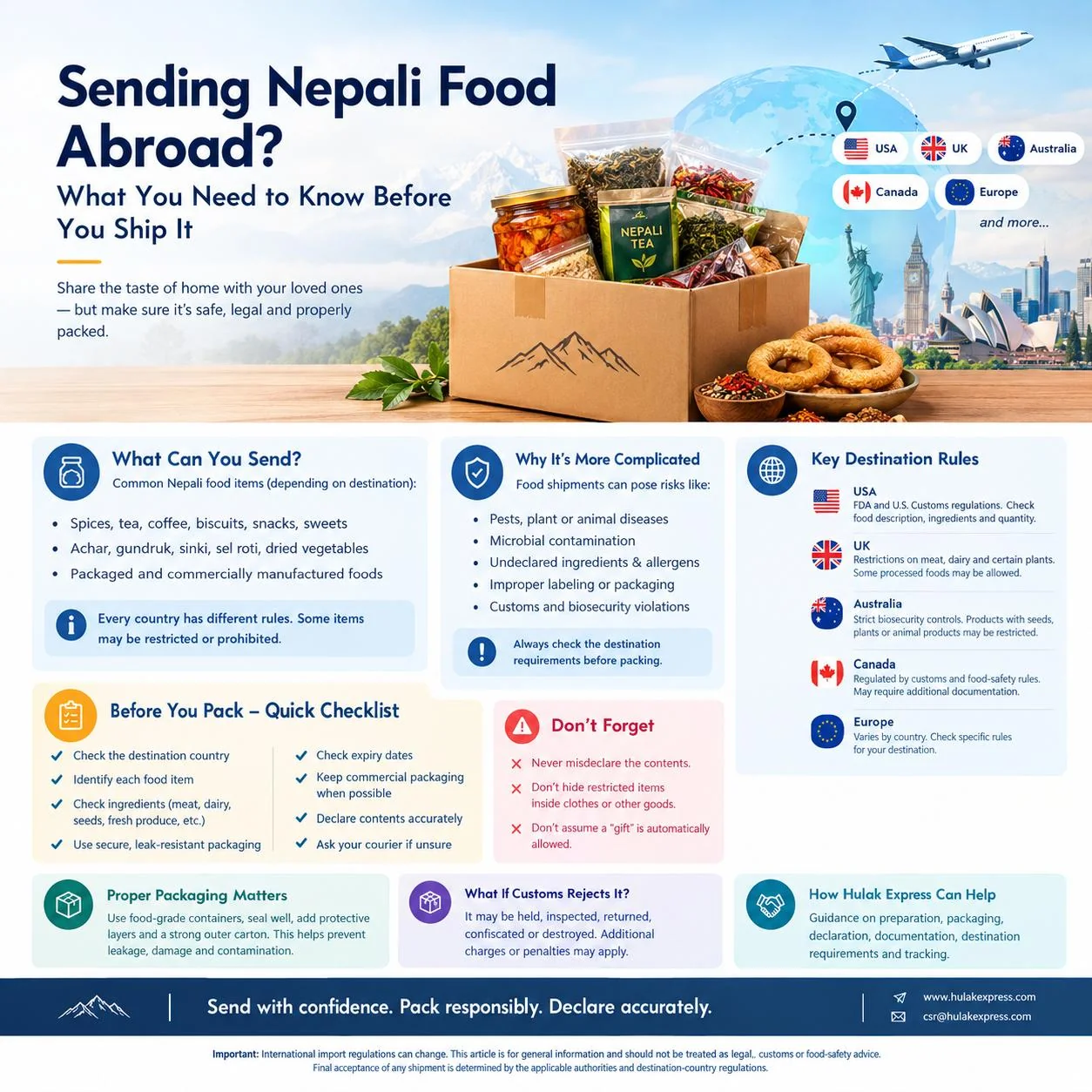
Every destination country has its own customs, food safety, biosecurity and import regulations. An item that can be shipped from Nepal to one country may be restricted or prohibited in another.
If you are planning to send Nepali food from Nepal to the USA, UK, Australia, Canada, Europe or another international destination, understanding the rules before booking a courier can help reduce the risk of delays, rejection, return or disposal.
This guide explains what you should know before sending food internationally with Hulak Express International Cargo & Courier.
Can You Send Nepali Food Abroad by Courier?
Yes, some types of food can be shipped internationally, but acceptance depends on:
- The type of food
- Ingredients used
- Whether it is homemade or commercially manufactured
- Packaging and sealing
- Country of origin
- Destination-country regulations
- Quantity and intended use
- Customs declaration
- Required permits or certificates
There is no universal list of "allowed Nepali food." Import regulations are determined by the destination country and can change.
For this reason, customers should check the destination requirements before packing the parcel.
Why Is Shipping Food Internationally More Complicated?
Food shipments can create several risks for destination countries, including:
- Agricultural pests
- Plant diseases
- Animal diseases
- Microbiological contamination
- Undeclared ingredients
- Allergens
- Improper labeling
- Food spoilage
- Leakage
- Customs and biosecurity violations
International customs authorities therefore inspect food shipments carefully.
A parcel described simply as "gift" or "food items" may not provide enough information for customs clearance. The contents should be declared accurately and specifically.
What Nepali Food Items Are Commonly Shipped?
Depending on the destination country's regulations, commonly requested items may include:
Dry and Packaged Foods
- Packaged spices
- Tea
- Coffee
- Biscuits
- Packaged snacks
- Instant noodles
- Packaged sweets
- Roasted or processed food
- Factory-sealed dry food products
However, being commonly shipped does not automatically mean an item is permitted. Each destination has different requirements.
Traditional Nepali Foods
Customers often ask about shipping:
- Achar
- Gundruk
- Sinki
- Masala and spices
- Sel roti
- Dry snacks
- Dried vegetables
- Traditional sweets
- Homemade food products
These products require particular care because some may be considered high-risk food, plant material, animal products, perishable goods or improperly packaged food depending on the ingredients and destination.
Homemade vs. Commercially Packaged Food
One of the most important factors is the difference between homemade food and commercially packaged food.
Commercially manufactured products generally have clearer information such as:
- Manufacturer name
- Ingredients
- Net weight
- Production information
- Expiry or best-before date
- Country of origin
- Food labeling
Homemade products may not have the same level of traceability or standardized packaging.
That does not mean every homemade food item is automatically prohibited everywhere. It means the destination country's rules must be checked carefully before shipping.
Shipping Food to the USA from Nepal
Food entering the United States is subject to regulations administered by agencies including the U.S. Food and Drug Administration (FDA) and U.S. Customs and Border Protection.
The FDA states that certain genuine non-commercial food gifts sent from one individual to another individual may qualify for specific treatment under its Prior Notice policy. However, the exact circumstances matter.
Therefore, customers should not assume that every food parcel labeled "gift" is automatically exempt from food-import requirements.
Before sending food to the USA, check:
- Exact food description
- Ingredients
- Manufacturer information where applicable
- Quantity
- Value
- Intended use
- Packaging
- Applicable FDA requirements
- Customs declaration requirements
Shipping Nepali Food to the UK
The UK has strict rules governing food and agricultural products entering Great Britain.
For example, personal imports from countries outside the EU are subject to restrictions on meat and meat products and milk or milk-based products, with limited exceptions. There are also restrictions affecting certain plants, fruits, vegetables, nuts and seeds.
This means products such as:
- Meat products
- Sukuti
- Dairy products
- Ghee
- Certain fresh agricultural products
may face significant restrictions depending on their composition and circumstances.
On the other hand, some processed and packaged foods can be treated differently under UK rules. The official guidance lists products such as biscuits, confectionery, certain pasta/noodles and packaged foods among items that may be allowed subject to the applicable conditions.
Shipping Food to Australia
Australia is well known for its strict biosecurity controls.
Food, plant materials and animal products may be subject to inspection, treatment, restriction or prohibition.
This is particularly important for products containing:
- Seeds
- Plants
- Fresh agricultural materials
- Meat
- Animal products
- Certain untreated foods
Even a small personal parcel can be inspected by Australian authorities.
For Australia-bound shipments, customers should check the requirements for the specific food item, rather than relying on a general "food is allowed" assumption.
Shipping Food to Canada
Canada also regulates food entering the country through its customs and food-safety framework.
The admissibility of a food product can depend on:
- Product type
- Ingredients
- Quantity
- Country of origin
- Intended use
- Packaging
- Whether it contains animal or plant products
Some products may be acceptable while others may require additional documentation or may be restricted.
Therefore, customers sending Nepali food to Canada should verify the rules for the exact item before shipping.
Why Accurate Customs Declaration Matters
One of the most important rules of international courier shipping is:
Do not describe a parcel containing food as:
- Clothes
- Documents
- Gift only
- Household items
- Personal effects
when the parcel actually contains food.
A better declaration would identify the product clearly, for example:
"Commercially packaged spice mix – 500 g"
or:
"Factory-sealed biscuits – 1 kg"
The declaration should be truthful and sufficiently detailed for customs processing.
Misdeclaration can result in:
- Customs delays
- Inspection
- Return to sender
- Confiscation
- Destruction
- Additional charges
- Penalties
Proper Packaging Is Essential for Food Shipments
Food can experience significant temperature, pressure and handling changes during international transportation.
Improper packaging may cause:
- Leakage
- Broken containers
- Damaged cartons
- Contamination
- Odor transfer
- Product spoilage
- Damage to other parcels
For liquid or oil-based foods such as achar, extra care is required.
Recommended Packaging Principles
1. Primary Packaging
Use a suitable food-grade, leak-resistant container.
2. Secondary Protection
Seal the product securely and add protective material around the container.
3. Absorbent Protection
Where appropriate, use suitable absorbent material to reduce the consequences of accidental leakage.
4. Strong Outer Packaging
Use a durable corrugated carton suitable for international transportation.
5. Internal Cushioning
Prevent the contents from moving freely inside the box.
6. Clear Labeling
Provide accurate product information wherever required.
Can You Send Homemade Achar Abroad?
This is one of the most frequently asked questions by Nepali customers.
Achar may contain:
- Oil
- Vegetables
- Fruits
- Spices
- Seeds
- Fish
- Meat
- Dairy ingredients
Each ingredient can affect import eligibility.
Homemade achar may also present packaging and leakage risks during transportation.
For this reason, customers should not assume that homemade achar can be shipped simply because it is a personal gift.
Before sending it, confirm whether the destination permits the specific product and whether it meets packaging and declaration requirements.
Can You Send Gundruk from Nepal Abroad?
Gundruk is a traditional fermented Nepali food and a popular item among Nepali communities overseas.
However, because gundruk is a plant-based food product, destination-country plant health, biosecurity and food-import requirements may apply.
For destinations with strict agricultural controls, acceptance can depend on:
- Processing method
- Packaging
- Product condition
- Quantity
- Documentation
- Country-specific biosecurity requirements
Do not assume that dried or fermented food is automatically exempt from inspection.
What About Sukuti, Meat and Dairy Products?
Extra caution is required for:
- Sukuti
- Meat products
- Ghee
- Cheese
- Milk products
- Meat-based achar
- Other animal-derived foods
Many countries impose strict restrictions on meat and dairy imports because of animal disease and biosecurity risks.
For example, Great Britain currently prohibits personal imports of meat and meat products and milk or milk-based products from countries outside the EU, subject to limited exceptions.
Food Shipping Checklist for Customers in Nepal
Before handing your parcel to a courier company, prepare the following:
✓ Check the Destination
Know the country and, where necessary, the specific import rules applicable there.
✓ Identify Every Food Item
Prepare an accurate list of the contents.
✓ Check Ingredients
Especially check whether the food contains:
- Meat
- Dairy
- Seeds
- Fresh vegetables
- Fresh fruits
- Animal products
✓ Check Packaging
Use secure, leak-resistant and transport-appropriate packaging.
✓ Check Expiry Dates
Avoid sending expired or near-expiry products.
✓ Keep Commercial Packaging Where Possible
Factory-sealed and properly labeled products are generally easier to identify during customs processing.
✓ Declare the Contents Accurately
Never intentionally misdeclare the parcel.
✓ Ask Before Shipping
If you are unsure whether an item can be shipped, ask the courier before packing the parcel.
What Happens If Customs Rejects a Food Parcel?
If a destination authority determines that an item does not meet its import requirements, possible outcomes can include:
- Shipment being held
- Additional documentation request
- Inspection
- Return to sender
- Confiscation
- Destruction
- Additional customs or handling charges
The final decision about whether an item may enter a country is generally made by the relevant destination-country authorities.
A courier company cannot guarantee that customs will release a restricted or non-compliant product.
How Hulak Express Helps with International Food Shipments
At Hulak Express, our goal is to make international courier shipping from Nepal easier and more transparent.
When customers want to send food, gifts or personal parcels internationally, we can help with the shipping process by guiding customers on:
- Shipment preparation
- Packaging considerations
- Content declaration
- Documentation
- Destination requirements
- International courier processing
- Tracking and shipment updates
However, customers remain responsible for ensuring that the contents they provide are legal and accurately declared.
For restricted products, additional documentation or special handling may be required.
Why You Should Check Before Packing Your Parcel
One of the most common mistakes is packing the entire parcel first and asking about restrictions later.
This simple process can reduce the chance of unnecessary delays and complications.
A Safer Way to Send Nepali Food Abroad
If you want to send Nepali food to relatives or friends overseas, consider choosing commercially manufactured, properly sealed and clearly labeled products where permitted.
Avoid sending:
- Prohibited foods
- Unapproved meat products
- Restricted dairy products
- Unprocessed agricultural materials
- Leaking liquids
- Expired products
- Poorly sealed containers
- Misdeclared goods
Customs authorities may inspect parcels using screening equipment and physical inspection. Incorrect declarations can create problems for both the shipment and the sender.
Frequently Asked Questions
Can I send Nepali food from Nepal to another country?
Some food products can be shipped internationally, but acceptance depends on the destination country's regulations and the specific food product.
Can I send homemade food abroad?
Some destinations may permit certain homemade foods under specific conditions, while others restrict them. Always check the destination requirements before shipping.
Can I send achar internationally?
It depends on the ingredients, preparation, packaging and destination. Oil-based or homemade achar may also require additional packaging precautions.
Can I send gundruk abroad?
Possibly, depending on the destination's food and biosecurity regulations. Plant-based products can be subject to specific import controls.
Can I send sukuti abroad?
Meat products are highly restricted in many countries. Check the destination regulations before attempting to ship sukuti.
Can I send ghee abroad?
Ghee is a dairy-derived product and may be restricted by some countries. Never assume that personal-use status makes it automatically admissible.
Is a food parcel automatically allowed if it is a gift?
No. "Gift" describes the purpose of a shipment; it does not automatically override import, food safety or biosecurity regulations.
What should I write on the customs declaration?
Provide an accurate description of each item, quantity, value and other information required by the shipping documentation.
Final Thoughts
Sending Nepali food abroad is a meaningful way to share the taste of home with family and friends. But international food shipping requires more than simply putting food into a box.
Destination-country regulations, accurate declarations, suitable packaging and proper documentation all matter.
The safest approach is to check the rules for the specific food and destination before shipping and to use accurate descriptions throughout the courier process.
Whether you are sending a small gift to family or arranging a larger international shipment, Hulak Express International Cargo & Courier can help you understand the shipping process and prepare your parcel appropriately.
Important: International import regulations can change. This article is for general information and should not be treated as legal, customs or food-safety advice. Final acceptance of any shipment is determined by the applicable authorities and destination-country regulations.


Comments (0)
No comments yet. Be the first to comment!
Leave a Comment